What Is Social Proof and Why Should You Care?
Influence and persuasion are core leadership skills. But in today’s organizations, influence increasingly happens without formal authority.
You may need to persuade:
-
Your boss or senior leaders
-
Peers across teams
-
Project stakeholders with no reporting relationship
-
Customers, partners, or regulators outside your organization
In all of these situations, your title carries limited weight. What matters instead is your ability to influence behavior, beliefs, and decisions. One of the most powerful and often invisible tools for doing that is social proof.
What Is Social Proof?
Social proof is a psychological phenomenon where people determine what is correct, appropriate, or desirable by observing what others are doing especially when they feel uncertain.
When we’re unsure:
-
Is this a good idea?
-
Is this acceptable behavior?
-
Is this the right decision?
We look around and ask ourselves, “What are people like me doing?”
That answer often guides our behavior, sometimes more than logic or evidence.
The Classic Study That Revealed Social Proof
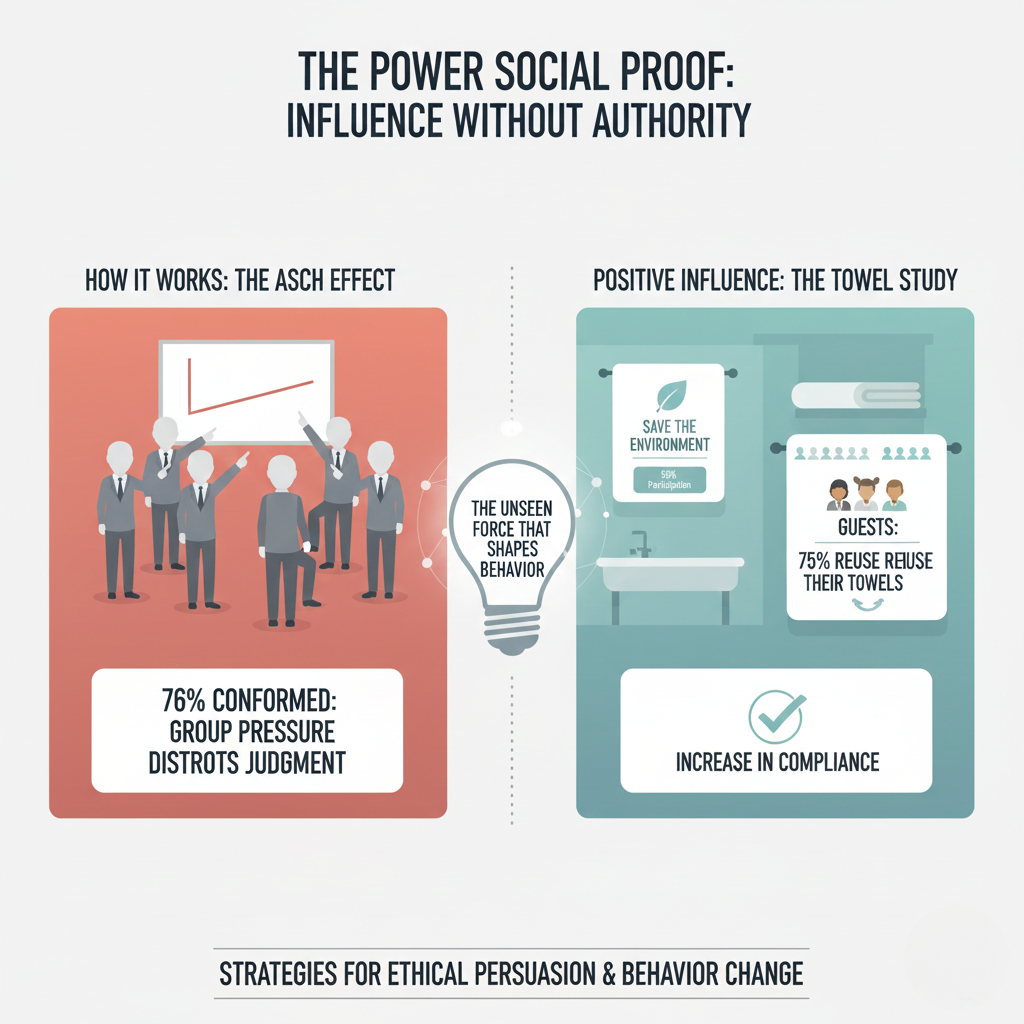
Psychologist Solomon Asch demonstrated the power of social proof in a famous experiment.
Participants were asked to compare the lengths of lines—an extremely simple visual task. When individuals answered alone, they were correct over 99% of the time.
But when surrounded by a group that intentionally gave the wrong answer:
-
76% of participants conformed at least once
-
Many knowingly gave incorrect answers
Why?
Some participants said they didn’t want to appear deviant—this is normative pressure.More troubling, others genuinely believed the group must be right—this is informational influence.
Social proof doesn’t just change behavior. It can distort judgment.
When Social Proof Becomes Dangerous
One of the most consequential studies on social proof was conducted by sociologist David Phillips.
He found that following front-page news coverage of suicides:
-
Fatal car crashes increased
-
Commercial and non-commercial airplane crashes increased
-
The spike sometimes reached 1,000%
-
The effect lasted 7–10 days
-
It occurred only in regions where suicides were heavily publicized
Why?
Public coverage legitimized the behavior. For people already uncertain or vulnerable, social proof made destructive actions seem more acceptable.
This research fundamentally changed how media covers suicides.
Using Social Proof for Positive Influence
Social proof isn’t inherently bad—it’s powerful. When used ethically, it can drive positive change.
The O-Power Example
The company O-Power was built entirely on social proof. Instead of telling people to conserve energy, they showed households how their energy use compared to their neighbors.
The result?
-
People reduced consumption simply by seeing what others were doing
-
No mandates, no authority—just comparison
Social proof became the engine behind behavior change, regulatory adoption, and business growth.
Towels in Hotels
Researchers tested two messages to encourage hotel guests to reuse towels.
Message 1 (Environmental Appeal):“Help save the environment by reusing your towels.”
Message 2 (Social Proof):“Join your fellow guests—75% of guests reuse their towels.”
The result?
- Guests exposed to social proof were 26% more likely to reuse towels
People didn’t change because they were told what to do.They changed because others like them were already doing it.
When Social Proof Stops Action
Social proof can also suppress positive behavior.
In emergency situations:
-
When alone, people help over 90% of the time
-
When surrounded by passive bystanders, only 16% help
Why?
People look to others for cues. If no one acts, inaction becomes the norm.
This is social proof working against us.
How to Use Social Proof Strategically
Social proof is most effective when:
-
People are uncertain
-
The source is similar to the target audience
Use Social Proof When:
-
You’re in the majority
-
You want to normalize a behavior
-
You want quick buy-in
Mitigate Social Proof When:
-
You’re in the minority
-
You want independent thinking
-
You need honest dissent
Why You Should Care
Social proof shapes decisions quietly but powerfully. It:
-
Influences judgment
-
Drives conformity
-
Can inspire positive change or suppress action
As a leader, teammate, or influencer without authority, understanding social proof gives you leverage. It allows you to:
-
Persuade ethically
-
Design better meetings
-
Avoid groupthink
-
Influence behavior without force
In a world where authority is limited, social proof is one of the most effective tools you have whether you choose to use it consciously or not.