What is Power in Organizations?
Power is one of the most studied and misunderstood concepts in organizational life. For more than a century, researchers, sociologists, and management scholars have tried to define it, measure it, and explain why some people seem to have it while others, with similar titles or roles, do not.
Understanding power is not about manipulation or dominance. It’s about understanding how influence works in real organizational settings and how individuals can navigate those dynamics ethically and effectively.
Power as the Potential for Influence
One of the earliest and most influential definitions comes from sociologist Max Weber (1914). Weber defined power as:
The ability of one actor to carry out their own will and achieve their goals, even in the face of resistance from others.
This definition highlights a critical idea: power is not influence itself, it is the potential for influence. You may not always exercise power, but having power means you can influence outcomes when needed, even if others disagree.
A similar idea appears in the well-known work of French and Raven (1959), who defined power as:
The maximum potential ability of one person (A) to influence another person (B).
Again, power is framed as a capacity, a source that enables influence rather than the act of influence itself.
Power as Control Over Outcomes
Another major way scholars understand power is through control over valued outcomes.
In 1962, Richard Emerson offered one of the most widely cited definitions of power:
Power resides in one’s control over things that another person values.
In other words, your power over someone depends on the extent to which you control resources, opportunities, or outcomes that matter to them such as information, approval, money, access, or career advancement.
Later research built on this idea, describing power as:
Asymmetrical control over another person’s outcomes—meaning one person has more influence over the other’s outcomes than vice versa.
This highlights that power is inherently relational. It exists within relationships, not in isolation.
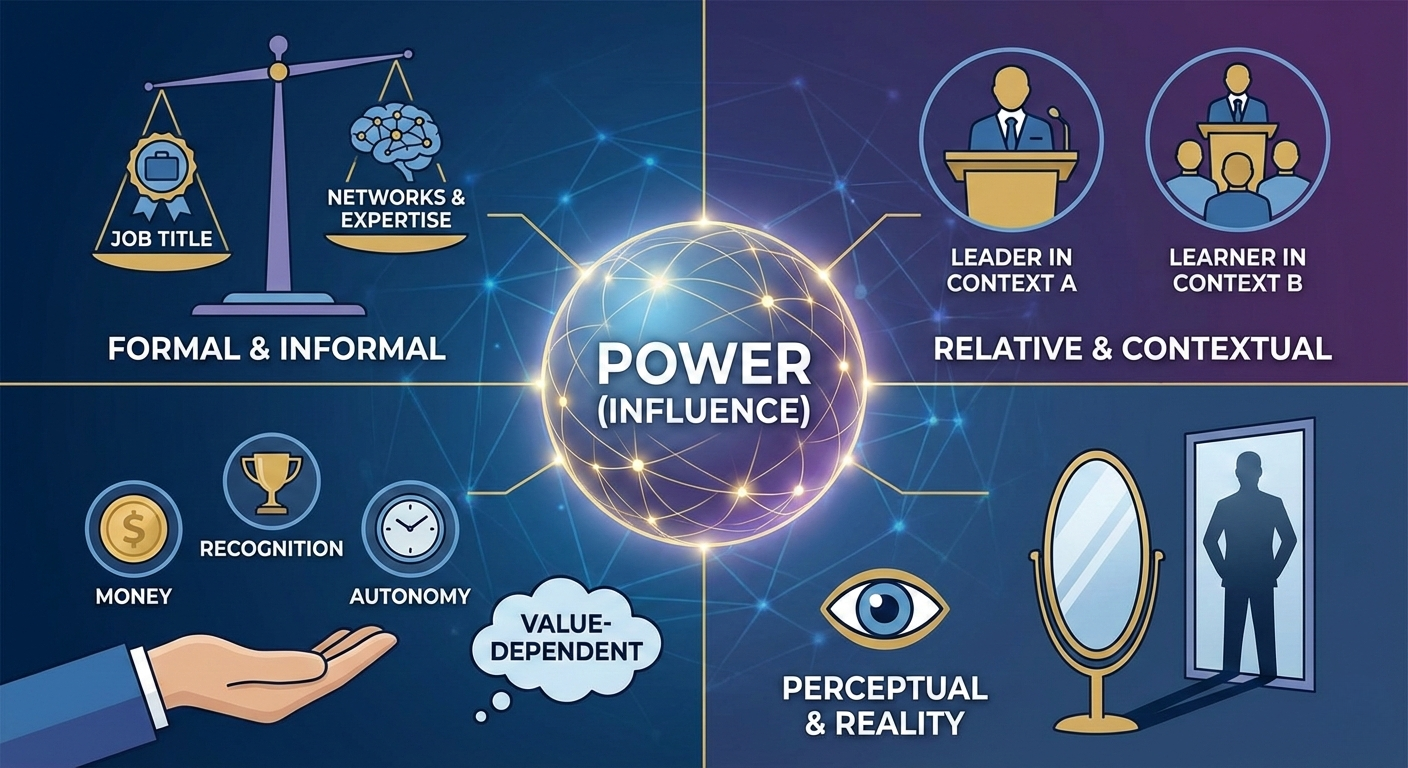
Core Dimensions of Power in Organizations
When we unpack these classic definitions, several foundational themes emerge. These dimensions help explain why power operates the way it does in modern organizations.
1. Power Is Relative and Contextual
Power is never absolute. It depends on who you are interacting with and in what context.
-
Your manager likely has more formal power over you.
-
In another meeting, you may be the most senior or knowledgeable person in the room—and therefore the most powerful.
Even globally influential figures are not always the most powerful in every situation. Power shifts depending on the social hierarchy, the setting, and the people involved.
2. Power Varies in Formality, Stability, and Legitimacy
Not all power comes from job titles.
-
Formal power comes from roles, authority, and organizational structures.
-
Informal power comes from relationships, expertise, reputation, or access to information.
Power also differs in how stable it is. In today’s knowledge-driven economy, information can quickly become outdated. If your power is based on rare expertise or insider knowledge, it may be temporary. By contrast, institutional authority such as holding a senior executive role is often more stable and legitimate, at least for a defined period.
3. Power Depends on What Others Value
Power only exists when the outcomes you control actually matter to others.
Organizations are diverse. Different people value different things:
-
Career growth
-
Recognition
-
Flexibility
-
Autonomy
-
Financial rewards
As a result, your power can vary significantly across individuals. You may have strong influence over one colleague and very little over another, depending on what each person values.
4. Power Is Both Actual and Perceptual
Power is not only an objective reality, it is also a social perception.
Sometimes people have little formal authority but are still seen as powerful. Social movements, influential employees, or thought leaders often begin with limited actual power but gain momentum by shaping perceptions.
When people believe someone is powerful, they start to behave differently around them. Over time, these perceptions can turn into more legitimate, stable, and formal sources of power.
In many cases, power is co-created through shared beliefs about who holds influence and who does not.
Why This Understanding of Power Matters
Two people can hold the same job title, sit at the same level in the organization, and yet experience vastly different levels of influence.
Why?
Because power is:
-
Relative
-
Contextual
-
Dependent on valued outcomes
-
Both real and perceived
Understanding these dynamics helps us move beyond simplistic ideas of authority and hierarchy. It allows us to see how influence actually works—and how individuals can ethically build their own bases of power.
Defining Power for Yourself
There is no single “correct” definition of power. Each of the perspectives above captures an important aspect of how power functions in organizations.
The real value lies in reflecting on:
-
Which definitions resonate most with your experience?
-
Where do you see power operating formally—and informally—around you?
-
How do perceptions shape influence in your workplace?
By developing your own working definition of power, you create a foundation for understanding how to build influence, navigate organizational dynamics, and lead more effectively.
Once we understand what power is, we can begin the more practical work: learning the strategies and practices that help individuals build both actual and perceived power—across relationships, teams, and organizations.