What Are the Types of Power in Organizations?
Influencing people is at the heart of organizational success. Whether you’re working with team members, managing subordinates, influencing your boss, or collaborating with stakeholders outside your organization, your ability to influence others shapes outcomes.
In fact, if you examine most definitions of leadership, you’ll find one common thread: leadership is influence. Titles alone don’t make leaders, people do. And power, especially informal power, is what enables that influence.
Power Beyond Titles and Authority
When people think of power, they often imagine heads of state, CEOs, or global business leaders, the kinds of individuals who appear on lists like Forbes’ Most Powerful People in the World. Presidents, prime ministers, popes, central bank leaders, and tech founders are commonly viewed as the ultimate holders of power.
But organizational power and influence more broadly does not belong exclusively to people with formal authority.
Consider social movements like:
-
The Occupy Central protests in Hong Kong
-
The Arab Spring
-
The Civil Rights Movement, led by Martin Luther King Jr.
Many of the individuals who sparked these movements had no formal authority, no titles, and no structural power. Yet they influenced millions. They claimed power, built it, and leveraged it effectively.
The same principle applies inside organizations: you don’t need a title to be influential.
Why Understanding Power Matters
Organizations rely on people behaving in certain ways to achieve goals. Leaders—formal or informal must motivate, align, and influence others to move in the same direction.
Power is not about control or intimidation. It’s about shaping behavior, decisions, and outcomes often without direct authority.
To understand how this works, researchers have identified six core bases of power that explain how influence operates in organizations.
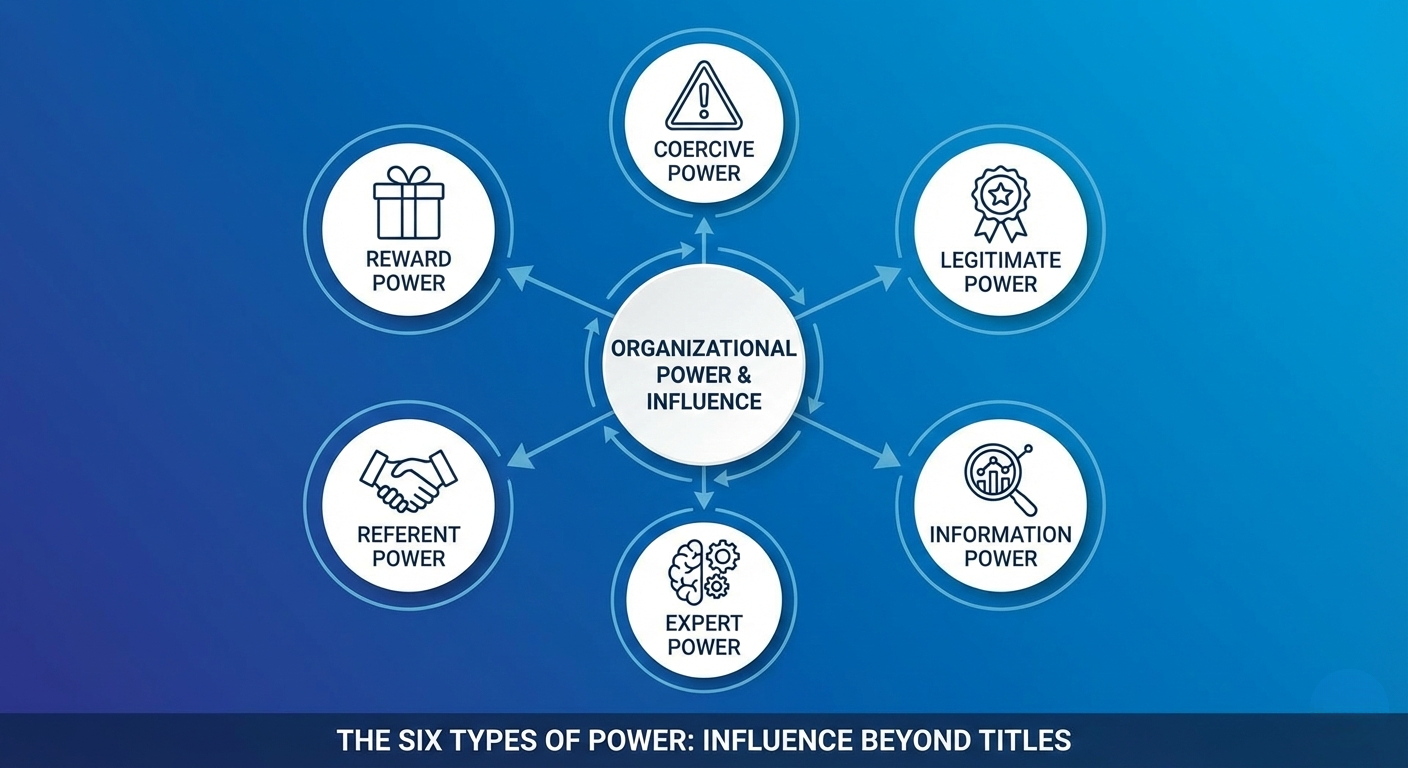
The Six Types of Power in Organizations
1. Reward Power
Reward power is the ability to provide positive outcomes in exchange for performance.
Examples include:
-
Promotions
-
Bonuses
-
Salary increases
-
Public recognition
-
Access to opportunities
If you can reward people for desired behavior, you hold power in that relationship. This type of power is common among managers but can also exist informally (e.g., recommending someone for a project or recognition).
2. Coercive Power
Coercive power is the ability to punish or enforce compliance.
This can include:
-
Disciplinary action
-
Demotions
-
Negative evaluations
-
Withholding opportunities
While coercive power can drive short-term compliance, research consistently shows it often damages trust, motivation, and long-term commitment if overused.
3. Legitimate Power
Legitimate power comes from formal authority.
This is the power embedded in:
-
Job titles
-
Organizational hierarchies
-
Reporting relationships
If someone is your manager, they have the formal right to influence your work. Legitimate power is clear and structured, but it is not always the most effective form of influence.
4. Referent Power
Referent power comes from personal connection, admiration, and identification.
People follow leaders with referent power because:
-
They respect them
-
They like them
-
They identify with their values
-
They feel personally connected
Charisma, trust, and authenticity are key drivers of referent power. This type of power is especially powerful because people want to follow, not because they have to.
5. Expert Power
Expert power is based on knowledge and skill.
If you possess:
-
Specialized expertise
-
Rare or valuable skills
-
Deep experience in a critical area
Others will naturally defer to you. Expert power becomes stronger when that expertise is both valuable and scarce in the organization or marketplace.
6. Information Power
Information power comes from access to valuable or rare information.
This could include:
-
Strategic insights
-
Market intelligence
-
Internal knowledge
-
Decision-making context
You don’t need to be the expert yourself, simply having access to key information can give you significant influence over others.
Which Types of Power Are Most Effective?
Not all forms of power are equally effective in every situation.
Some drive compliance. Others inspire commitment.Some work best in the short term. Others build long-term influence.
The effectiveness of each type depends on:
-
The situation
-
The people involved
-
Organizational culture
-
How the power is used
Many experienced leaders find that referent, expert, and information power are often more sustainable and effective than coercive or purely legitimate power, especially when influencing without authority.
Power as a Skill You Can Build
One of the most important insights about power is this:
Power is not fixed. It is not reserved for people at the top.
No matter where you sit in the organization—entry-level, middle management, or senior leadership—you can build influence by developing the right forms of power.
Effective leadership is not about wielding the biggest stick. It’s about influencing people and processes even when you don’t have formal authority.
Final Thoughts
Understanding the different types of power helps you:
-
Influence more effectively
-
Lead without authority
-
Build trust and credibility
-
Navigate organizational dynamics strategically
As you reflect on your own experience, ask yourself:
-
Which types of power do I rely on most?
-
Which ones have I seen used effectively—or poorly?
-
Which forms of power should I develop next?
Influence is learnable. Power is buildable. And leadership begins long before a title ever does.