What Are the Risks of Power?
Power can be a tremendous asset. As we’ve seen, it fuels action, creativity, resilience, and even health. But power also comes with real risks. If we want to build power responsibly and use it effectively, we must understand not only its benefits, but also its potential costs.
Research over the past several decades is clear on one thing: power changes how people think, feel, and behave. And while some of those changes are positive, others can quietly undermine individuals, teams, and entire organizations.
Let’s explore the key risks of power and why leaders must handle it with care.
Power Leads to Overconfidence
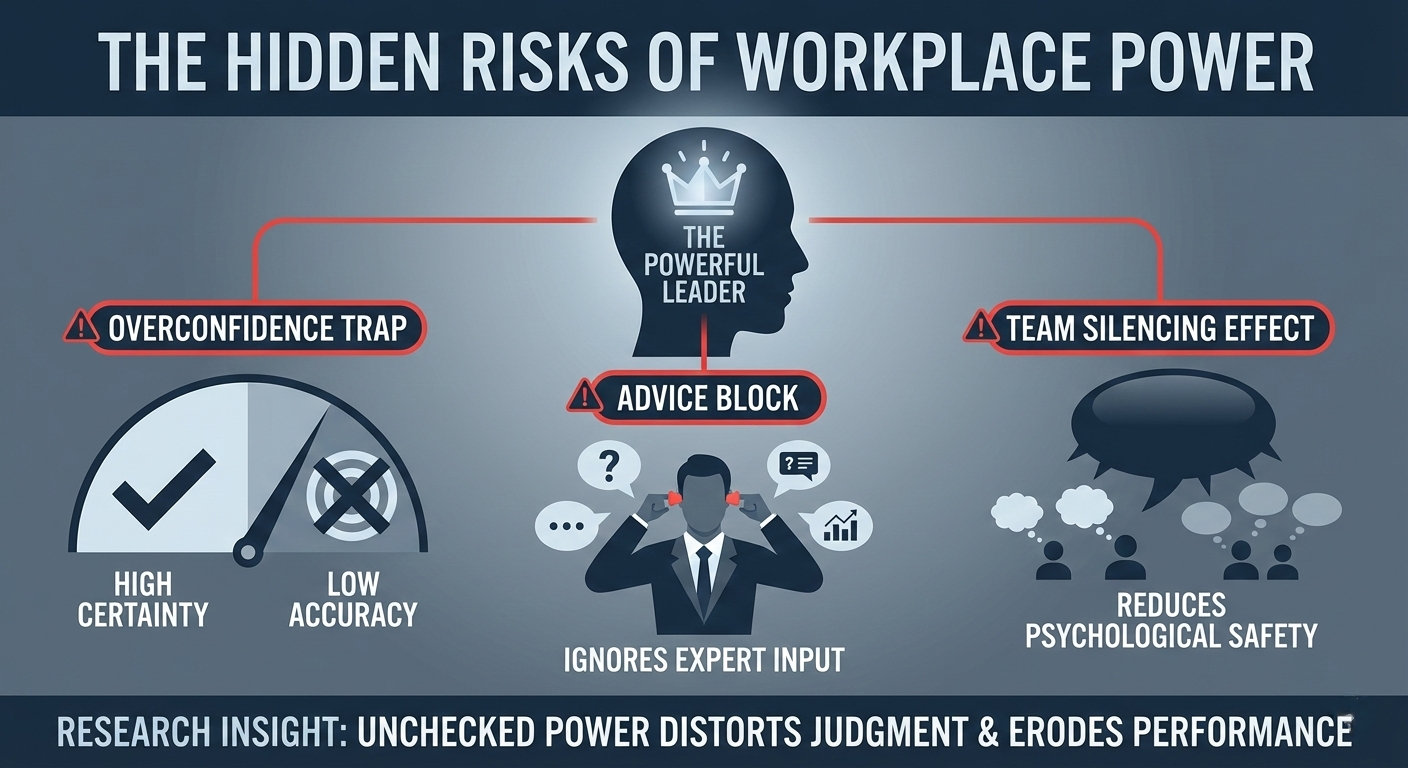
Confidence is essential for leadership. Leaders must make decisions, set direction, and act decisively. However, power often pushes confidence past a healthy threshold into overconfidence.
Research shows that when people are primed to feel powerful, they become far more certain about their judgments even when they lack information.
In one study, participants were asked to make estimates on unfamiliar tasks and provide a confidence interval (a range where they believed the correct answer would fall). Those who felt powerful:
-
Provided much narrower confidence intervals
-
Expressed greater certainty
-
Were more wrong than those who felt powerless
Meanwhile, people who felt powerless were less confident—but their estimates were actually closer to the correct answer.
This highlights a dangerous paradox of power:
The more powerful you feel, the more certain you become—and the more likely you are to be wrong.
Power Reduces Willingness to Take Advice
One of the most damaging effects of power is its impact on listening.
Across multiple studies and diverse samples—students, working adults, managers, and professionals—research consistently finds that as power increases:
-
Confidence increases
-
Willingness to seek or use advice decreases
Powerful individuals are less likely to incorporate input from others into their decision-making. This holds true even when:
-
The advice is high-quality
-
The advisor is an expert
-
The task is complex and uncertain
In one study, people in powerful roles who believed they were experts were more likely to bet confidently on incorrect answers—and lose money—compared to those who recognized they were not the expert.
In modern organizations, where no single person has all the information, this is especially dangerous. Overconfidence combined with ignored advice creates a perfect storm for poor decisions.
Power Encourages Self-Focus Over Team Focus
Another critical risk of power is that it shifts attention inward.
Research shows that when people feel powerful, they become more self-focused rather than focused on others or the collective. In one study, participants were asked to write about inspirational moments in their lives.
-
People in low-power states wrote about themselves and others equally
-
People in high-power states wrote nearly twice as many stories about themselves as about others
This self-focus can subtly erode leadership effectiveness. Leaders may begin to:
-
Prioritize their own ideas
-
Attribute success to themselves
-
Pay less attention to team contributions
Over time, this undermines collaboration and shared ownership.
Power Can Silence Teams and Reduce Performance
Perhaps the most concerning risk of power emerges at the team level.
Research shows that when formal leaders feel highly powerful relative to their team members, several things happen:
-
Leaders talk more
-
Team members talk less
-
Communication becomes less open
-
Psychological safety declines
In studies examining team decision-making, teams with a highly power-primed leader were significantly less likely to reach the correct solution on complex tasks compared to:
-
Teams with neutral-power leaders
-
Teams with no formal leader at all
The reason is straightforward: valuable information stays silent. Team members with unique insights hesitate to speak up, while the leader dominates the conversation—often unknowingly.
Ironically, the leader’s sense of power ends up hurting both team performance and their own effectiveness.
Power Can Destroy Value If Left Unchecked
Taken together, these risks reveal the darker side of power:
-
Overconfidence replaces accuracy
-
Listening gives way to certainty
-
Self-focus crowds out collective focus
-
Communication shuts down
-
Decision quality declines
Power doesn’t automatically corrupt—but unchecked power distorts judgment.
This is especially important for leaders in formal authority roles. Feeling powerful is often unavoidable. But internalizing that power too deeply—believing you are unquestionably right, superior, or indispensable—can quietly erode trust, engagement, and results.
The Leadership Challenge
The real challenge is not avoiding power. Power exists in every organization and every relationship.
The challenge is learning how to:
-
Hold power without becoming overconfident
-
Lead with authority while remaining open
-
Use influence without silencing others
-
Balance confidence with humility
Understanding the risks of power is the first step toward using it wisely.
Only once we understand both the benefits and the costs of power can we begin to build it responsibly—and ensure that power creates value rather than destroys it.