What Are the Benefits of Power?
Power is often discussed in terms of hierarchy, authority, or control, but far less often in terms of its benefits. Once we move beyond seeing power as something reserved only for senior leaders, and instead understand it as a psychological and relational resource, a very different picture emerges.
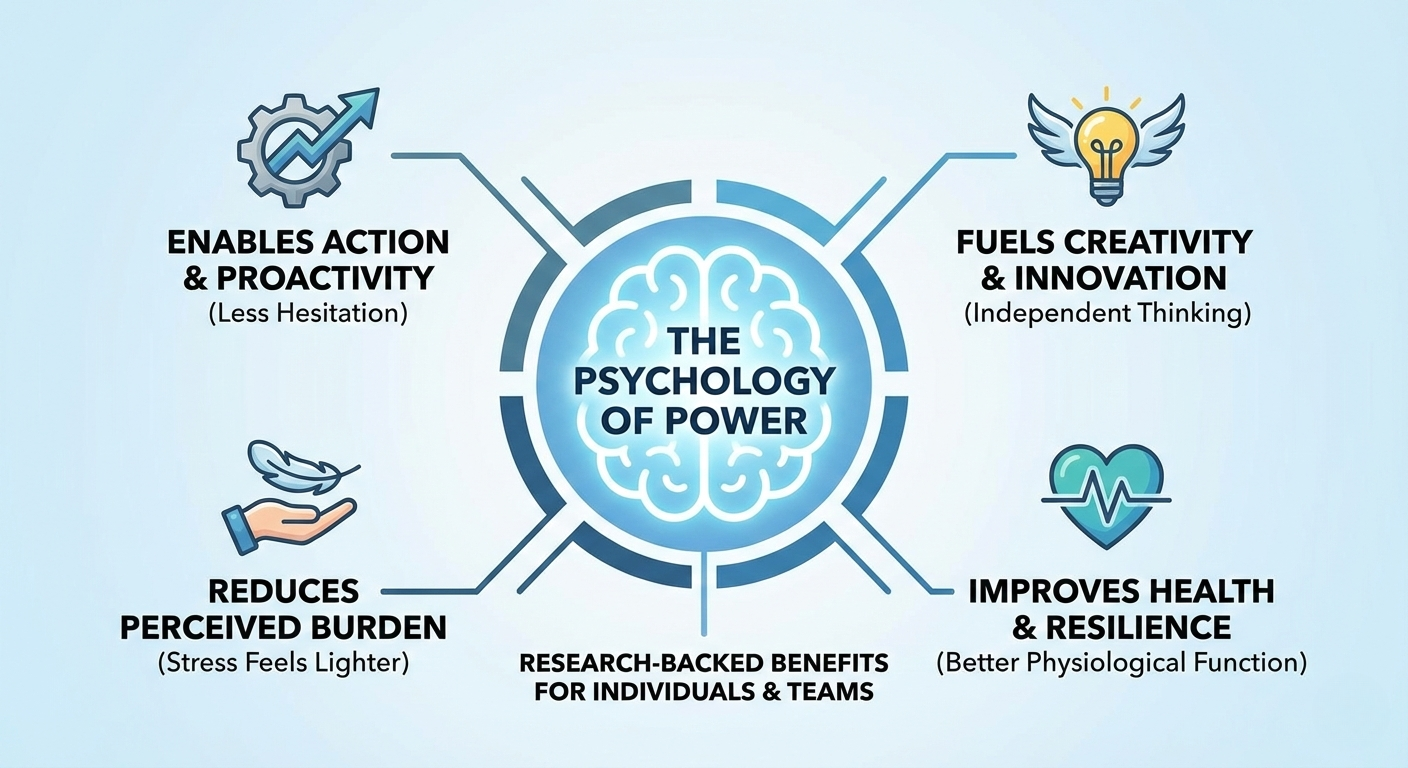
Modern research shows that power does far more than enable influence. It shapes how people think, act, feel, and even how their bodies respond. When used responsibly, power can be a force for individual growth, team effectiveness, and organizational success.
Let’s explore what the research tells us about the benefits of power.
Power Enables Action and Proactivity
One of the most consistent findings in recent research is that power drives action.
In organizations, we often want people who don’t wait to be told what to do, people who anticipate problems, step up, and take initiative. Research by Adam Galinsky, Joe Magee, and colleagues shows that feeling powerful significantly increases this kind of proactive behavior.
In experimental studies, participants were primed to feel either high power or low power—sometimes by assigning them leadership roles, and sometimes simply by asking them to write about a time they felt powerful or powerless. Remarkably, this psychological shift alone changed behavior.
-
In a blackjack-style task, over 90% of people in a high-power mindset took a calculated risk, compared to less than 60% in a low-power mindset.
-
In another study, participants worked in a room with a loud, annoying fan. Only about 40% of low-power participants took action to fix the problem. Nearly 70% of high-power participants did.
The takeaway is clear: power reduces hesitation. When people feel powerful, they are more likely to act, address problems, and take responsibility, exactly the behaviors organizations need.
Power Fuels Creativity and Innovation
Creativity requires people to challenge assumptions, question norms, and resist conformity. Power plays a critical role here.
Research shows that people who feel powerful are less likely to conform to others’ opinions, even when faced with social pressure. In studies where participants were given false feedback about what others believed, those in a high-power mindset were far more willing to trust their own judgment.
This has major implications for teams and organizations:
-
Powerful individuals think more independently
-
They are less constrained by “how things have always been done”
-
They are more willing to propose novel ideas
In short, power enables innovation. When team members feel empowered, creativity flourishes.
Power Reduces the Feeling of Burden
Another surprising benefit of power is how it affects our perception of responsibility.
Two people can carry the same workload, yet one experiences it as an exciting opportunity while the other feels overwhelmed. Research suggests that power changes how heavy life feels—literally.
In one study, participants were asked to estimate the weight of boxes. Before any power manipulation, everyone estimated the weights similarly. But after participants were primed to feel powerful or powerless:
-
Those in a low-power state overestimated the weight
-
Those in a high-power state underestimated the weight
Psychologically, weight perception maps onto feelings of burden and responsibility. When people feel powerful, responsibility feels lighter. When they feel powerless, the same responsibility feels heavier and more exhausting.
This suggests that power can help people cope better with stress and responsibility by changing how challenges are perceived.
Power Has Real Health Benefits
Perhaps the most striking benefit of power is its impact on physical health.
In laboratory studies, participants were primed to feel powerful or powerless and then connected to physiological monitors. The results were dramatic:
-
Cardiac output (a measure of heart efficiency) was nearly four times higher in high-power states
-
Vascular resistance, which makes it harder for blood to flow, was significantly lower in high-power states
These changes occurred in real time, driven solely by how powerful or powerless participants felt. The psychology of power directly affected cardiovascular functioning.
This research suggests that power doesn’t just help us influence others—it may also support better physiological functioning and resilience under pressure.
Career and Organizational Benefits of Power
Beyond these psychological and physiological effects, power also brings more familiar advantages:
-
Faster career advancement
-
Greater access to resources
-
Increased autonomy and discretion
-
A stronger voice in decision-making
But perhaps most importantly, power can be a collective asset. When power is shared and distributed appropriately:
-
Teams become more proactive
-
Organizations become more innovative
-
Employees experience less stress and burnout
-
Better decisions get made
Power isn’t only beneficial for the individual who holds it, it can create value for entire teams and organizations.
The Good Side of Power
Power often has a negative reputation, associated with dominance or misuse. But the research tells a more balanced story.
Power:
-
Encourages action
-
Enables creativity
-
Reduces perceived burden
-
Improves physiological functioning
-
Helps individuals and teams perform at a higher level
The key is not whether power exists—because it always does—but how it is built, experienced, and used.
Understanding the benefits of power allows us to think more intentionally about how to empower ourselves and others. And it sets the stage for the next important conversation: the risks, costs, and dark side of power.
Because while power can do a great deal of good, it must be handled with care.