How Does Cognitive Bias Affect Decision Making?
We often like to believe that our decisions are rational, objective, and based purely on facts. In reality, human judgment is deeply shaped by cognitive biases, mental shortcuts that help us process information quickly but often distort our thinking.
What’s especially important to understand is that many cognitive biases don’t just affect judgment; they can also become powerful tools of influence. When used intentionally, they shape how people evaluate options, assess risks, and choose between alternatives.
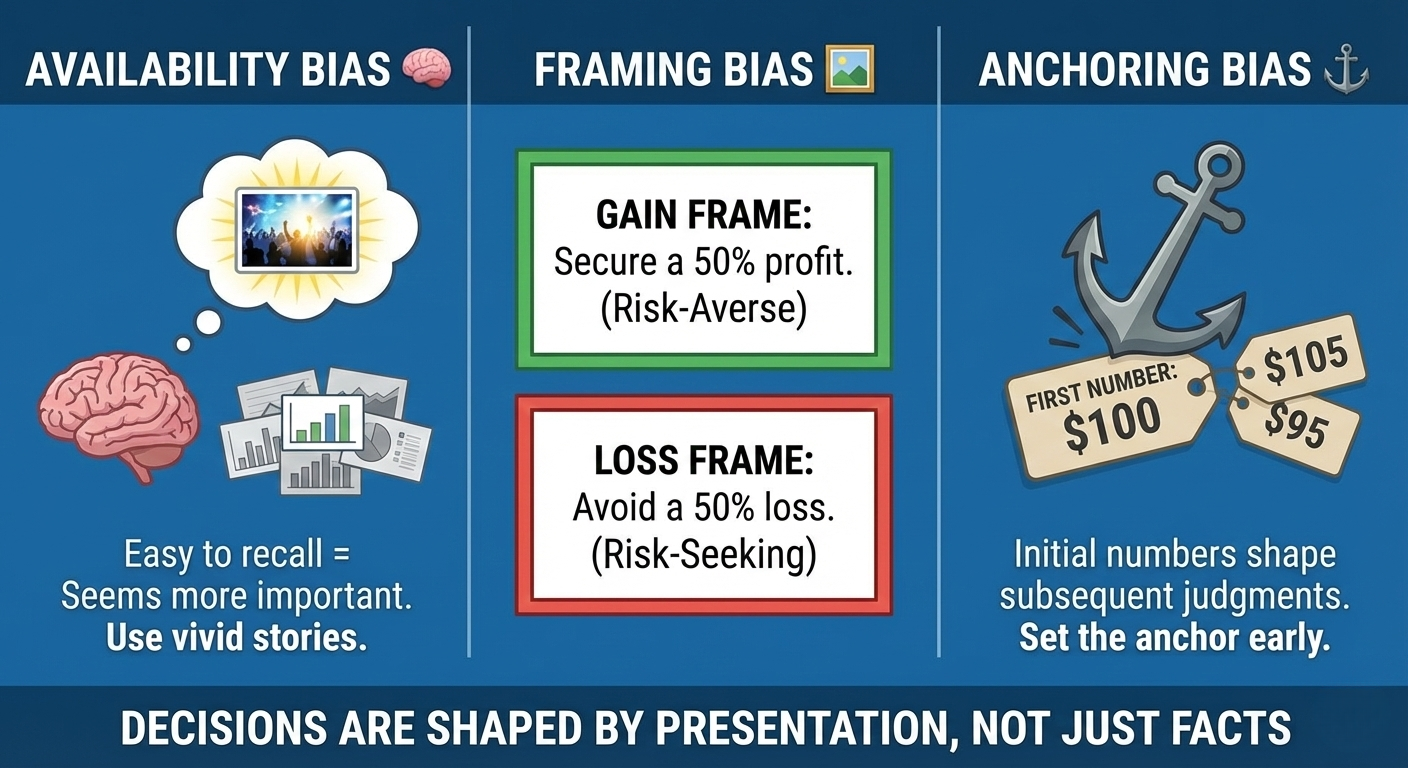
Three of the most influential cognitive biases in decision making are availability, framing, and anchoring. Together, they explain why the same facts can lead to very different decisions depending on how they are presented.
Availability Bias
The availability bias (or availability heuristic) refers to our tendency to give more weight to information that is vivid, memorable, and easy to recall. If something is easy to imagine or visualize, we assume it must be important or common.
This bias shows up frequently in performance evaluations. Managers often overemphasize the most recent meetings or interactions when rating employees, simply because those moments are easier to remember.
Availability bias is also a powerful influence tactic.
How Availability Bias Shapes Decisions
-
Stories are more persuasive than spreadsheets
-
Seeing beats reading
-
Experiencing beats being told
Instead of showing declining customer satisfaction scores, bring in a dissatisfied customer to tell their story. Instead of handing out a brochure, let customers experience a prototype. These approaches activate availability bias by making information vivid and emotionally engaging.
Framing Bias
Another powerful bias is framing, a concept central to Prospect Theory, developed by Daniel Kahneman and Amos Tversky. Their research showed that people respond very differently to choices depending on whether options are framed as gains or losses.
Consider this simple choice:
-
A sure gain of $500
-
A 50% chance of gaining $1,000
Most people choose the sure gain.
Now reverse the frame:
-
A sure loss of $500
-
A 50% chance of losing $1,000
Suddenly, people prefer the gamble.
The insight is striking:
-
When options are framed as gains, people become risk-averse
-
When options are framed as losses, people become risk-seeking
Why Framing Matters
Framing allows the same proposal to push people toward either caution or boldness:
-
“We can gain 11% market share by entering this market” (gain frame)
-
“If we don’t enter, we miss the chance to gain 11% market share” (loss frame)
Both statements describe the same reality but they trigger different risk preferences.
Anchoring Bias
The anchoring bias occurs when people rely too heavily on an initial number or estimate even if that number is arbitrary. Once an anchor is set, subsequent judgments adjust only slightly from that starting point.
In one study, managers were asked to estimate the salary of a newly hired engineer. Before estimating, they were told that an administrative assistant had guessed either:
-
$70,000 (low anchor), or
-
$120,000 (high anchor)
The resulting salary estimates differed by $14,000, despite the guess being meaningless.
Anchoring is especially powerful in:
-
Negotiations
-
Budget discussions
-
Goal setting
-
Performance evaluations
Whoever speaks first often shapes the entire conversation.
Anchoring in Practice
-
Start budget discussions with competitor benchmarks rather than last year’s numbers
-
Open goal-setting conversations with top-performer data instead of averages
-
Lead negotiations with a strong first offer
The discussion will tend to orbit around that initial anchor.
The Bigger Picture
Availability, framing, and anchoring show us something important about human decision making:
Decisions are not just about facts, they’re about presentation.
These biases influence what people notice, how they interpret information, and how much risk they are willing to take. When used ethically, they can help leaders communicate more effectively and guide better decisions. When ignored, they can quietly distort judgment.
Understanding cognitive bias doesn’t eliminate it—but it gives you the power to recognize when your decisions are being shaped by something other than logic.
And that awareness is one of the most valuable decision-making tools you can have.