How Does Authority Influence Human Behaviour?
When we talk about influence and persuasion, we often emphasize influence without authority, convincing people when you don’t have formal power over them. But there’s an important twist to this idea:
Most of the time, people don’t respond to real authority.They respond to symbols of authority.
Titles, uniforms, credentials, clothing, and status cues often matter more than actual expertise or legal power. Few experiments demonstrate this more powerfully than the work of psychologist Stanley Milgram.
Obedience to Authority
In the early 1960s, Stanley Milgram designed a study that appeared to be about memory and learning. Participants were assigned the role of “teacher,” while another person—the “student”—was tasked with memorizing word pairs.
Each time the student made a mistake, the teacher was instructed to administer an electric shock.
In front of every teacher was a shock generator with 30 switches, starting at 15 volts and increasing in 15-volt increments all the way up to 450 volts—clearly labeled with warnings like “Severe Shock” and “Danger.”
With each mistake, the teacher was told to increase the voltage.
The student (an actor) screamed, protested, begged to stop, and eventually fell silent. The shocks were fake—but the teachers didn’t know that.
The key question Milgram asked was simple and chilling:
How far would ordinary people go when instructed by an authority figure?
What Experts Predicted—and What Actually Happened
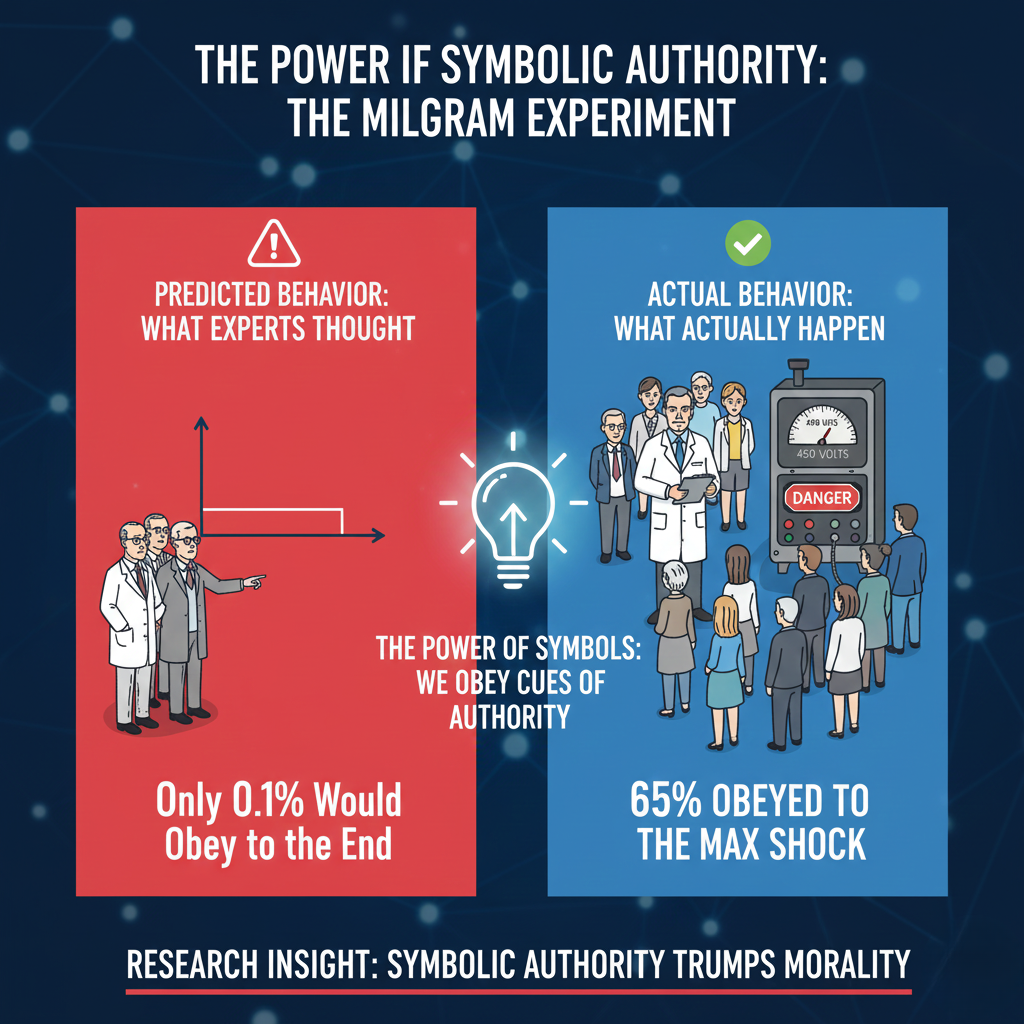
Before running the experiment, Milgram surveyed experienced psychiatrists. Their predictions were confident:
-
Only 3.7% would go as high as 300 volts
-
Fewer than 0.1% would administer the maximum 450 volts
The reality was very different.
-
100% of participants administered 300 volts
-
About two-thirds went all the way to 450 volts
-
Many continued administering shocks until the experimenter told them to stop
Why?
Because a man in a white lab coat—the experimenter—stood calmly in the room and said things like:
“Please continue.”“The experiment requires that you go on.”“I take responsibility.”
This wasn’t real authority in the legal or moral sense. It was symbolic authority.
We Obey Symbols, Not Just Power
Milgram’s findings weren’t isolated. A vast body of research shows that humans are remarkably sensitive to signals of authority, even when that authority is irrelevant or illegitimate.
Titles Matter
In one study:
-
Over 95% of professionally trained nurses were willing to administer an unsafe and unauthorized medication
-
The only reason?The person giving the order introduced himself as a doctor over the phone
No credentials were verified. The title alone was enough.
Status Shapes Everyday Behavior
Authority cues influence even trivial decisions:
-
If a car in front of us doesn’t move at a green light, we usually honkBut studies show that when the car is newer or more expensive, people wait longer before honking
-
Shoplifters dressed in suits and ties are reported far less often than those wearing casual clothes
-
A jaywalker wearing business attire is 3.5 times more likely to be followed than one dressed casually
We often don’t realize it—but we’re constantly scanning for signs of who deserves deference.
Authority as an Influence Tool
Authority is one of the most powerful and dangerous influence mechanisms. Used ethically, it can accelerate decisions and build trust. Used carelessly, it can override judgment and morality.
If you want to use authority responsibly as an influence tactic, consider:
-
Dressing professionally when credibility matters
-
Developing and signaling genuine expertise
-
Using industry-specific language appropriately
-
Highlighting support from respected, high-status individuals
You don’t need to boast, signals are often enough.
Protecting Yourself from Blind Obedience
Just as important is learning how to resist illegitimate authority.
On the receiving end:
-
Ask whether the authority is legitimate
-
Ask whether it is relevant to the situation
-
Separate confidence and status from actual expertise
-
Pause when someone says, “Just trust me”
Authority should guide thinking, not replace it.
Final Thought
Human beings are not just influenced by arguments and evidence. We are deeply influenced by who delivers the message and how they appear.
Authority works not because it’s always right but because we are wired to comply with it.
Understanding this doesn’t make you manipulative. It makes you aware.
And awareness is the first step toward ethical influence.